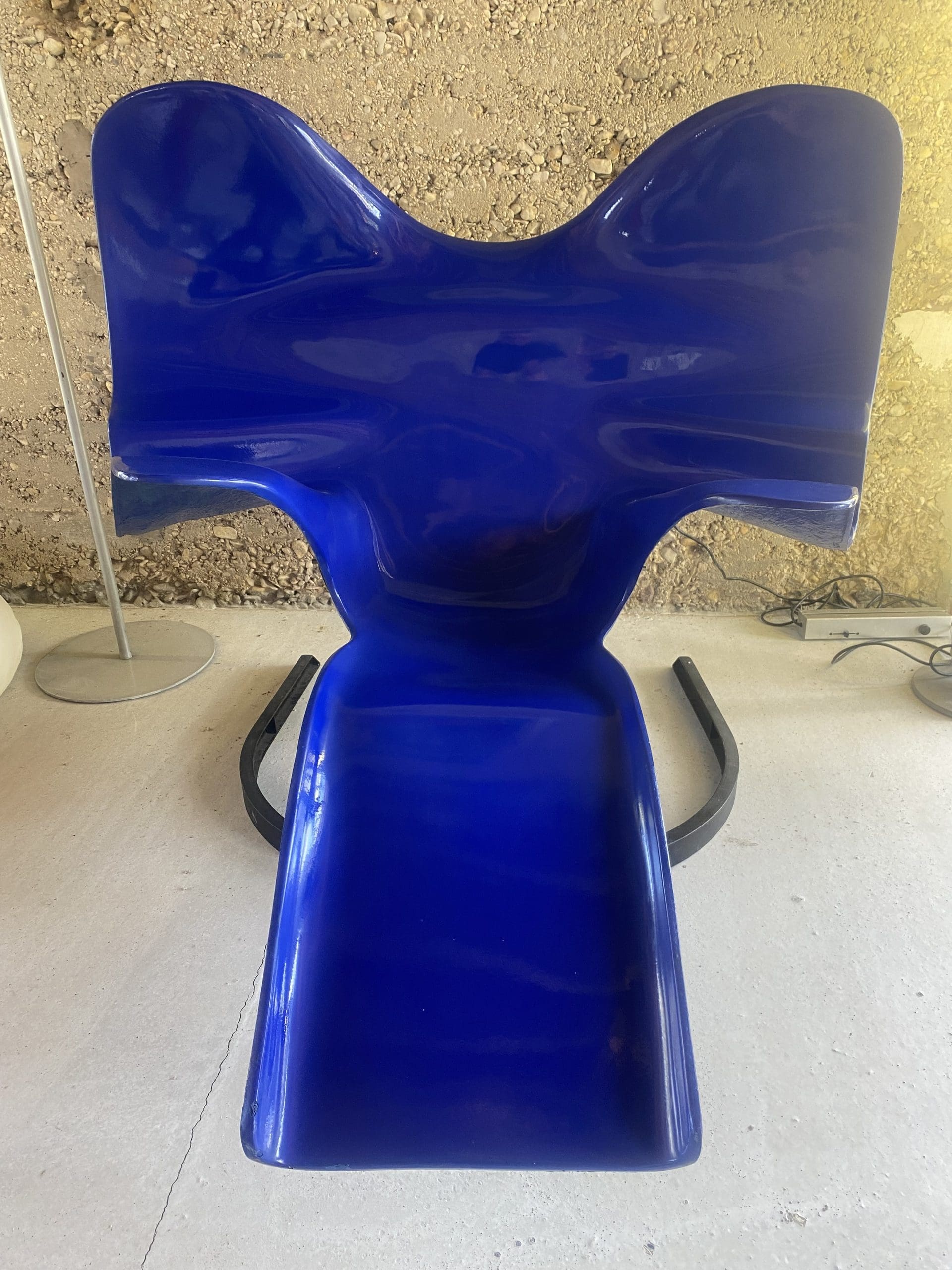
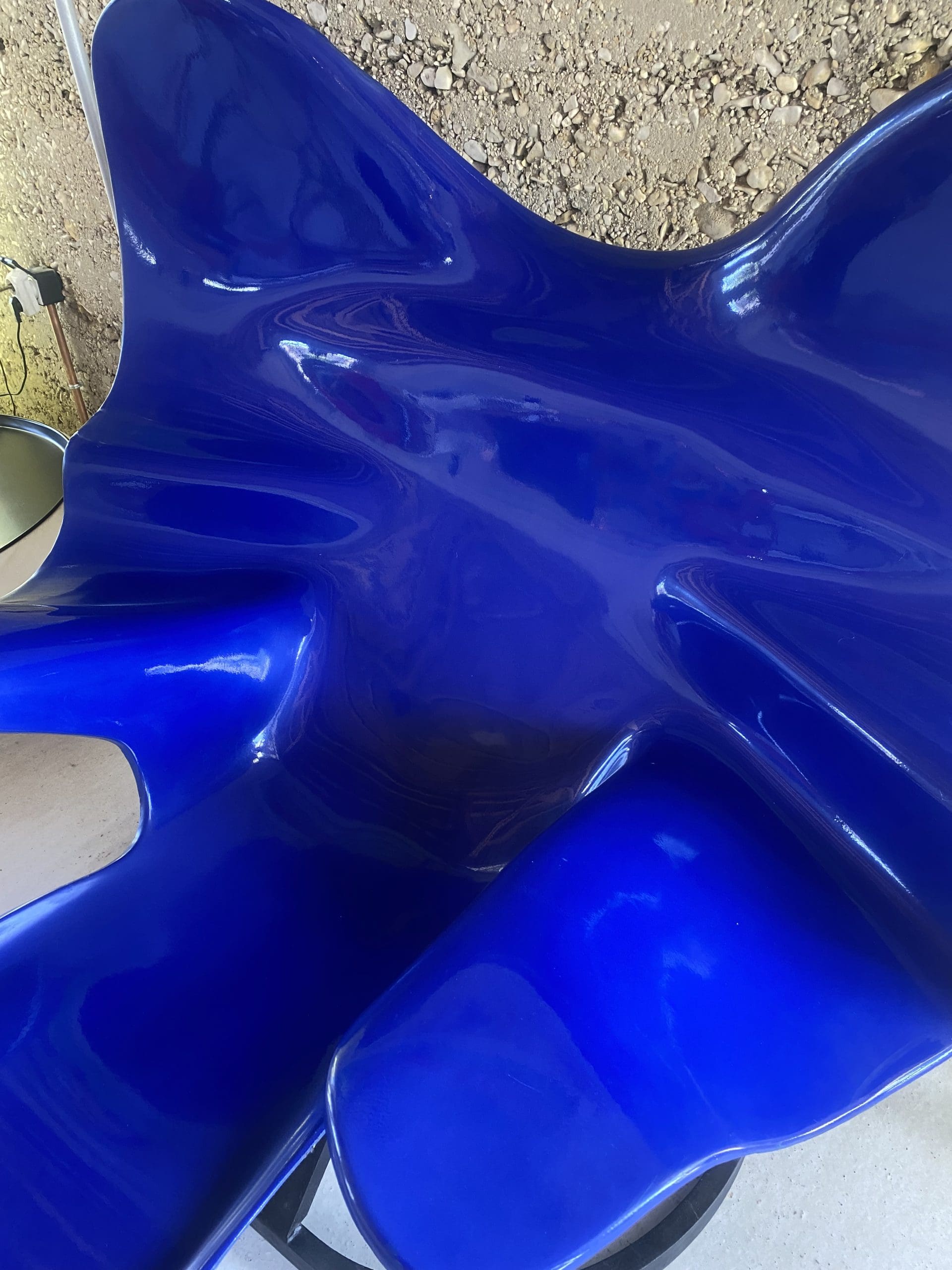
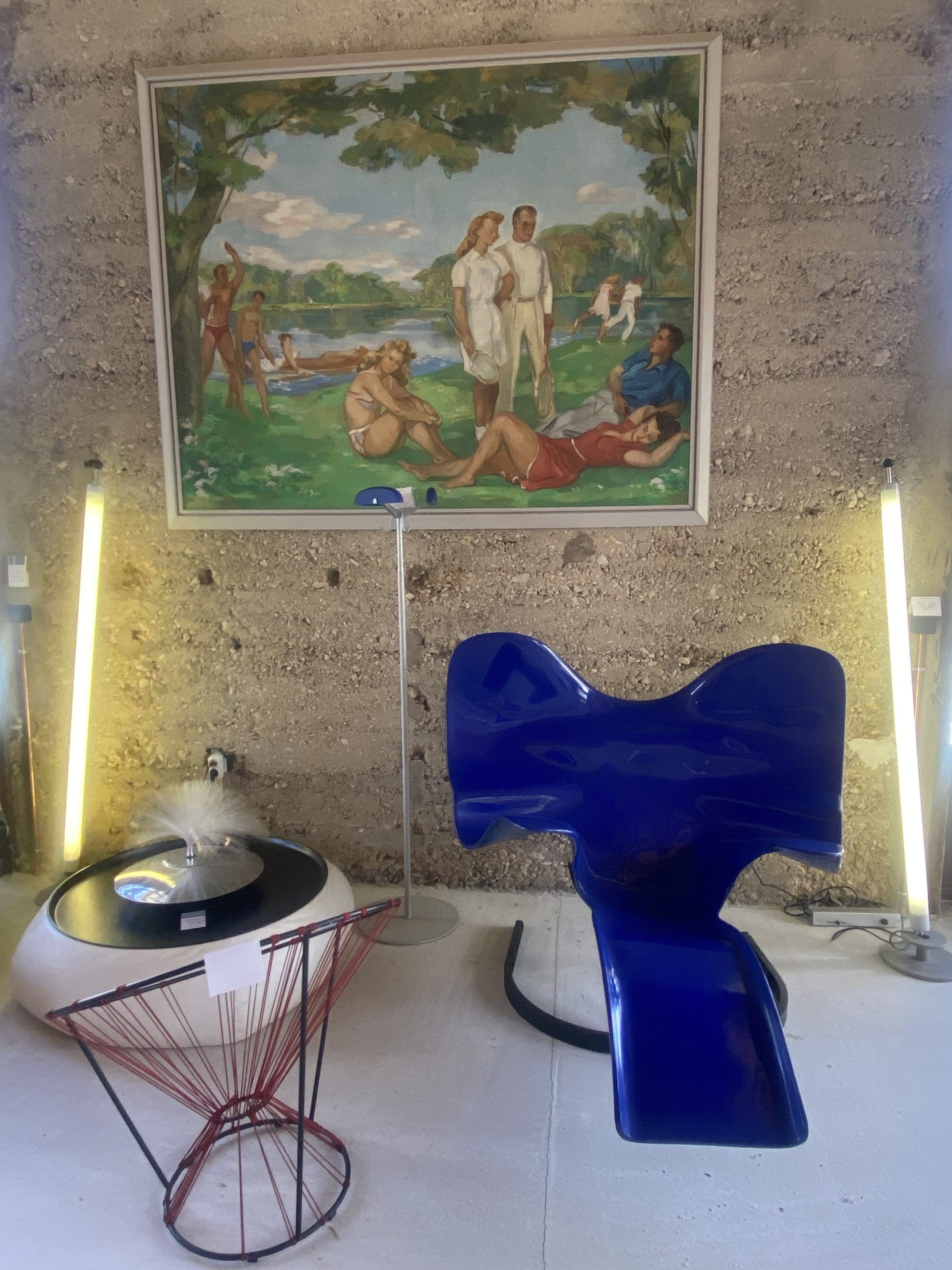
Bernard Rancillac — Elephant Armchair, fiberglass and wrought iron, Klein blue

14 900 €
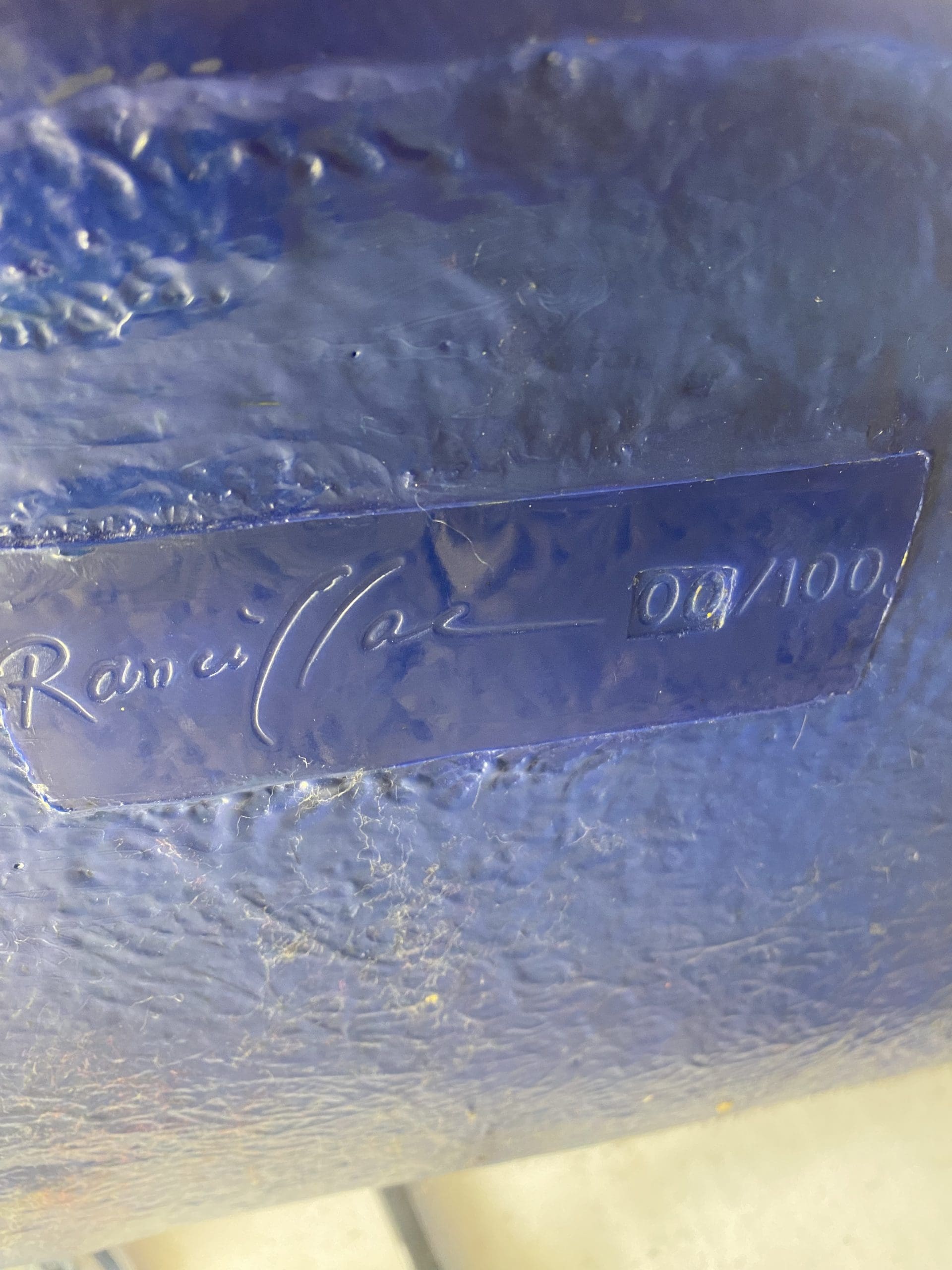
Elephant Chair by Bernard Rancillac, limited numbered edition 00/100, unique copy in Klein blue. Sculpture-seat in fiberglass and wrought iron Created in 1972 — the only piece of furniture designed by this pioneer of Narrative Figuration. An exceptional collector's item at the crossroads of art and design.
| Designer | Bernard Rancillac (1931–2021) |
| Model | Elephant Chair |
| Entry Date | Original design 1966, this example 1972 |
| Edition | Limited edition numbered 00/100 — unique copy in Klein blue |
| Mouvement | Narrative figuration / Art-design |
| Materials | Fiberglass, wrought iron, metal |
| Color: | Klein Blue (International Klein Blue) |
| Size | H 110 × W 114 × D 150 cm (H 43.3 × W 44.9 × D 59.1 in) |
| Weight | 70 kg |
| State | Good condition |
| numbering | Numbered 00/100 |
Bernard Rancillac's Elephant Armchair — The only piece of furniture by a master of Narrative Figuration
This Elephant chair by Bernard Rancillac is an absolutely unique piece in the history of French design. Made in 1972 from fiberglass and wrought iron, this numbered example (00/100) is the only one in the series to have been produced in Klein blue—that deep, vibrant blue made famous by Yves Klein, another major figure in postwar French art. The Elephant chair is not simply a seat: it is a habitable sculpture, born from the imagination of a painter who designed only one piece of furniture in his entire career.
Bernard Rancillac (1931–2021), co-founder of the Narrative Figuration movement alongside Télémaque, Monory, and Erró, is primarily known for his politically engaged paintings, his series on jazz, and his political portraits with their acidic and saturated palettes. In 1966, he designed the Elephant armchair—his only foray into the world of furniture design. This unique piece in his oeuvre reflects the same formal freedom and audacity as his paintings: organic curves, an imposing sculptural presence, and a complete rejection of conventional functionalism.
Technical specifications of the Rancillac Elephant armchair
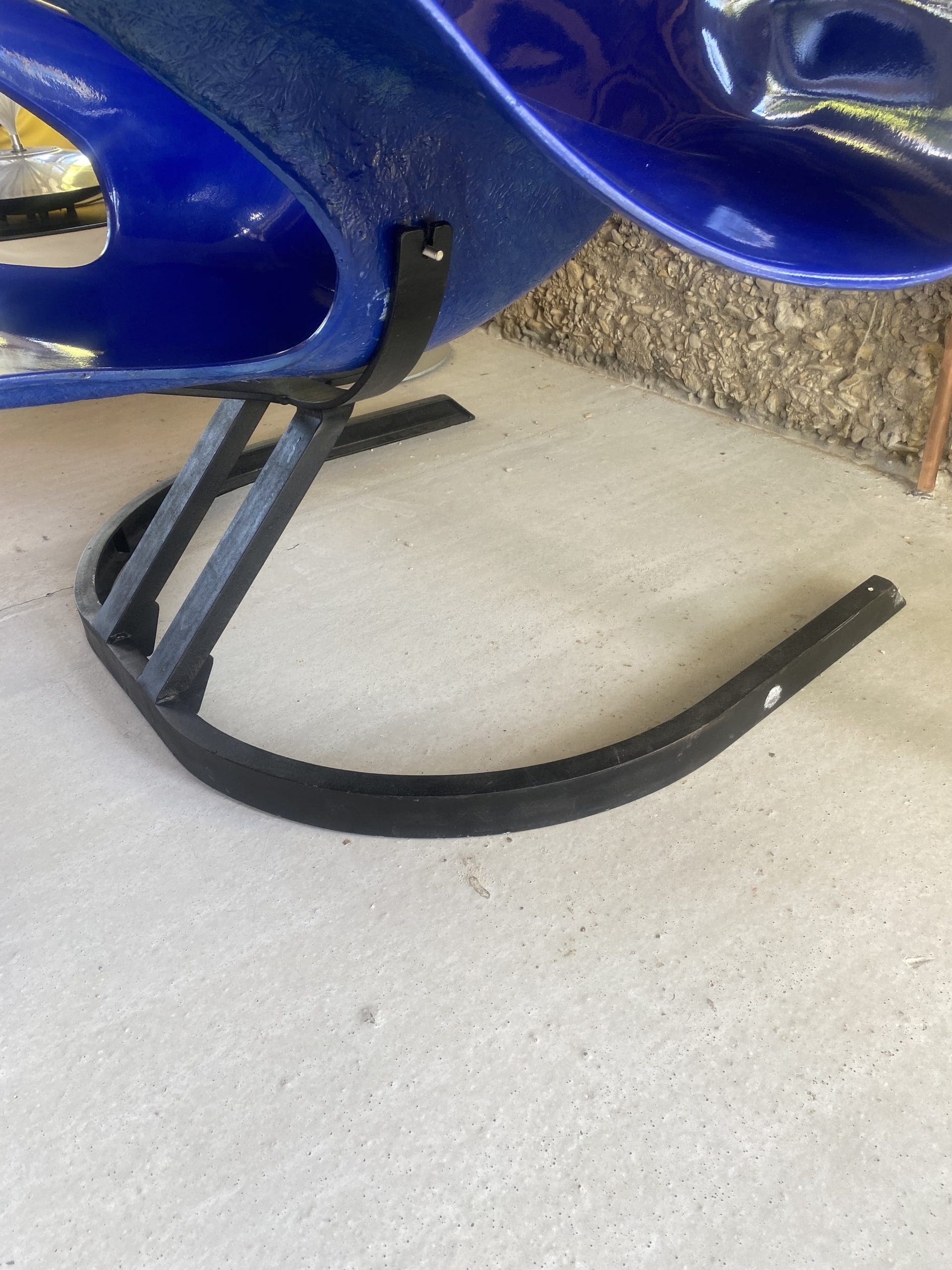
Rancillac's Elephant armchair boasts generous proportions: 110 cm high, 114 cm wide, and 150 cm deep, weighing 70 kg. The fiberglass shell—a material favored by designers in the 1960s and 1970s for its plasticity and structural lightness—rests on a wrought iron frame that ensures overall stability. Its form evokes the silhouette of a stylized elephant, somewhere between an enveloping seat and a zoomorphic sculpture, in keeping with the tradition of organic seating of the era.
The edition is strictly limited to 100 copies, and this copy bears the number 00/100 — traditionally reserved for the artist or the reference proof. Its Klein blue finish distinguishes it from all other copies in the series, making this Rancillac Elephant armchair a truly unique piece.
Bernard Rancillac and narrative figuration
Born in Paris in 1931, Bernard Rancillac trained at the Atelier Met de Penninghen before becoming one of the major players in the French art scene of the 1960s. In 1964, he participated in the seminal exhibition "Mythologies quotidiennes" at the Musée d'Art Moderne de la Ville de Paris, which marked the official birth of Narrative Figuration — a resolutely committed movement that draws on popular imagery, the media and current political events to construct a new pictorial language.
Exhibited at MoMA in New York, the Centre Pompidou, and the MAC VAL, Rancillac left behind a considerable body of work. The Elephant armchair, however, remains his most surprising and rarest creation: an object straddling the line between art and design, perfectly embodying the spirit of an era when artists and designers shared the same ambitions for the liberation of forms.
Conservation state
This Elephant chair by Bernard Rancillac is in good overall condition. The fiberglass shell retains its characteristic Klein blue hue, and the wrought iron frame is solid and stable. Normal signs of wear, consistent with the piece's age (over 50 years), attest to its authenticity.
It is extremely rare to be able to offer a Bernard Rancillac Elephant armchair—and even rarer in this configuration. Numbered 00/100 and the only example in Klein blue, this piece occupies a fascinating intersection: that of contemporary French art (Rancillac's work is exhibited at the Pompidou Centre, MoMA, and MAC VAL) and collectible design. It is the only piece of furniture ever created by one of the founders of Narrative Figuration, which gives it a unique status in the history of artist-designed furniture.
For collectors, the appeal is twofold: it is both a signed work of art by a renowned artist (his paintings regularly fetch six figures at auction) and a functional object with a striking sculptural presence. The Klein blue adds another layer of interpretation—an implicit homage to Yves Klein, Rancillac's contemporary in the vibrant Parisian art scene of the 1960s.
— The team The Auctionlab
Shipping Country: France, Denmark, Ireland, Latvia, Lithuania, Belgium, Finland, Liechtenstein, Jersey, Sweden, Iceland, United Kingdom (UK), Monaco, Turkey, Spain, Gibraltar, Greece, Portugal, Andorra, Italy, Austria, Bulgaria, Luxembourg, Poland, Germany, Hungary, Switzerland
Delivery status: Nebraska (United States (USA)), Arkansas (United States (USA)), New Mexico (United States (USA)), Colorado (United States (USA)), Oregon (United States (USA)), Idaho (United States (USA)), Wyoming (United States (USA)), Kansas (United States (USA)), North Dakota (United States (USA)), Minnesota (United States (USA)), Alaska (United States (USA)), Montana (United States (USA)), Arizona (United States (USA)), Nevada (United States (USA)), California (United States (USA)), Oklahoma (United States (USA)), Hawaii (United States (USA)), Texas (United States (USA)), Iowa (United States (USA)), Utah (United States (USA)), Louisiana (United States (USA)), Illinois (United States (USA)), Connecticut (United States (USA)), Virginia (United States) (USA)), Pennsylvania (USA), Alabama (USA), Vermont (USA), Ohio (USA), Missouri (USA), Tennessee (USA), North Carolina (USA), Mississippi (USA), Kentucky (USA), South Carolina (USA), New York (USA), Michigan (USA), Indiana (USA), New Jersey (USA), Massachusetts (USA), Maryland (USA), Georgia (USA), Maine (USA), Florida (USA), Washington (USA), District of Columbia (USA), West Virginia (USA), Wisconsin (USA), Rhode Island (United States (USA)), New Hampshire (United States (USA)), Delaware (United States (USA))
Ready to ship in 3 to 5 working days from France
Shipping information
Delivery & Insurance
🚚
Worldwide delivery — Competitive rates & insured shipping
Delivery price
The delivery cost is calculated after the product is added to the cart.
For specific requests or multiple items, a personalized quote can be provided upon request.
France & Europe
- Small objects: Delivery within 1 week.
- Bulky products: Delivery time is 2 to 6 weeks depending on destination and carrier.
- Delivery type: at the bottom of the building or at the door (ground floor).
A premium delivery or installation service can be offered upon request.
International delivery
We deliver worldwide via carriers specializing in designer furniture and precious objects.
For an international quote or an estimate of delivery times, please contact us.
Packaging & Transport
Each item is packaged with the utmost care and entrusted to professional carriers.
To guarantee delivery in perfect condition, all shipments are systematically insured.
Return Policy
Returns & Refunds
↩️
Return conditions & refund procedures
In accordance with European regulations on distance selling, customers located in the European Union have a
14-day deadline after delivery to exercise their right of withdrawal, under certain conditions.
For more information, see our
CGU / CGV
or contact us directly.
We can also provide you with additional photos or videos of the product before purchase to help you confirm your choice with complete peace of mind.
Returns outside Europe
Outside the European Union, the right of withdrawal does not apply. Returns are therefore not accepted.
generally not accepted due to logistical and customs constraints.
However, certain specific situations can be studied. case by case.
We recommend that you carefully check all product information (condition, photos, dimensions, description) before confirming your purchase.
| Weight | 70 kg |
|---|---|
| Size | 110x114x150 cm |
| Designer | |
| Color | |
| Material |
Auctionlab by(1 Reviews)
- Shop name: shop by Auctionlab
- Address: 49 bld saint denis, 92400 COURBEVOIE, France
- Phone: + 33146677289
Information request


Similar lots
-
 Speed Chaise Longue in Wrought Iron and Rattan - Tom Dixon
1 950.00 €
Seller
-
Ico Parisi - Lounge armchairs 875 used
6 900.00 €
Seller
-
Set of 4 chairs model CM 145 by Pierre Paulin, circa 1955
1 750.00 €
Seller
-
Pierre Jeanneret daybed in black cowhide - Timeless elegance of modernist design
35 000.00 €
Seller
-
Set of 6 Charlotte Perriand Chairs for Les Arcs – Modernist Design from the 60s
5 400.00 €
Seller
-
Paulin sofa model 442 – Icon of French design from the sixties
4 700.00 €
Seller
-
Jean Prouvé – Grand Repos armchair with footrest
5 900.00 €
Seller
-
Jean Prouvé – Model supervisor's desk circa 1950
1 900.00 €
Seller
-
Triassic Petrified Wood – Polished Fossil Stool
1 500.00 €
Seller
-
Marc Held — High-backed tumbling chair in fiberglass and green jersey
12 900.00 €
Seller