


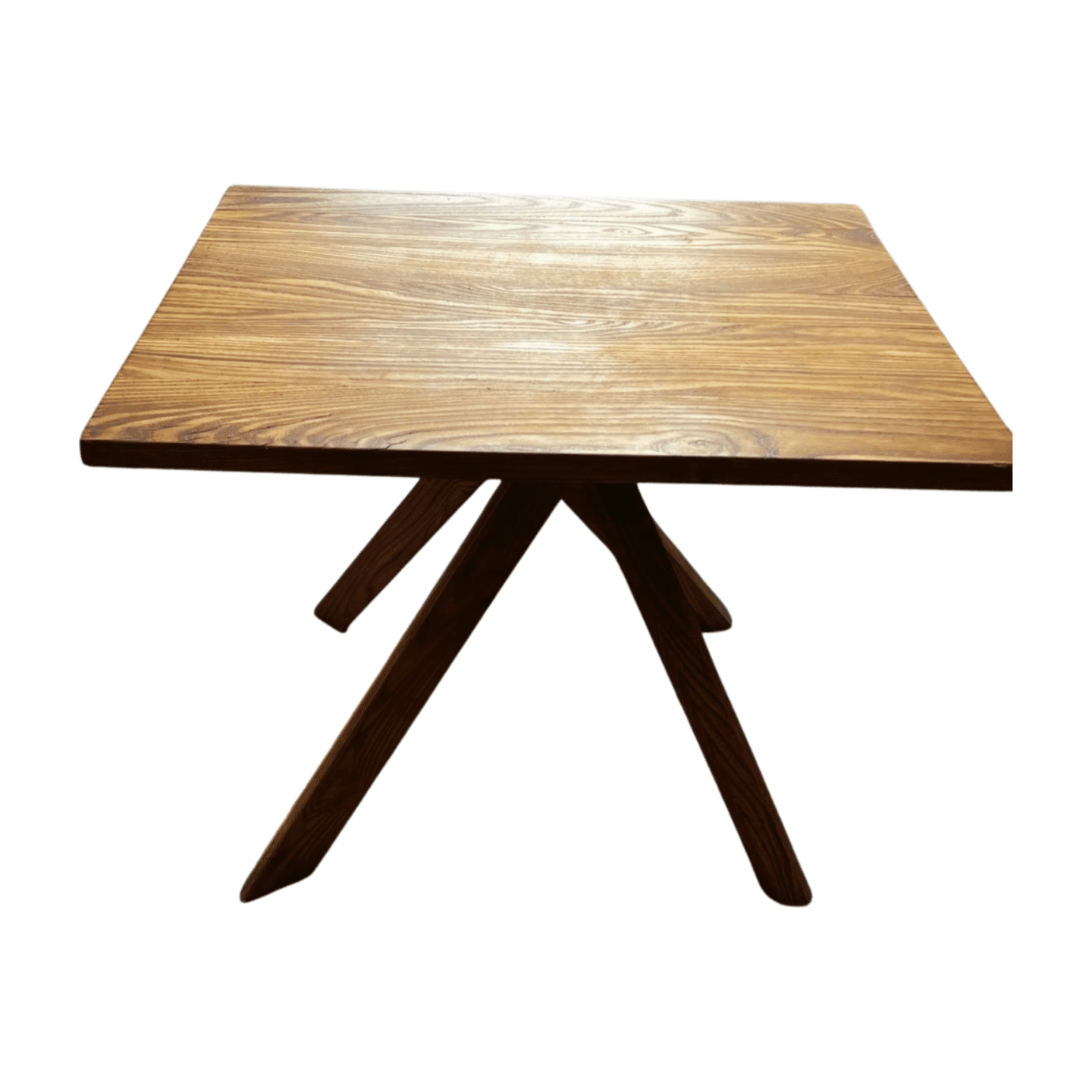
Pierre Chapo — T27A dining table in solid pine, X-shaped base

3 900 €
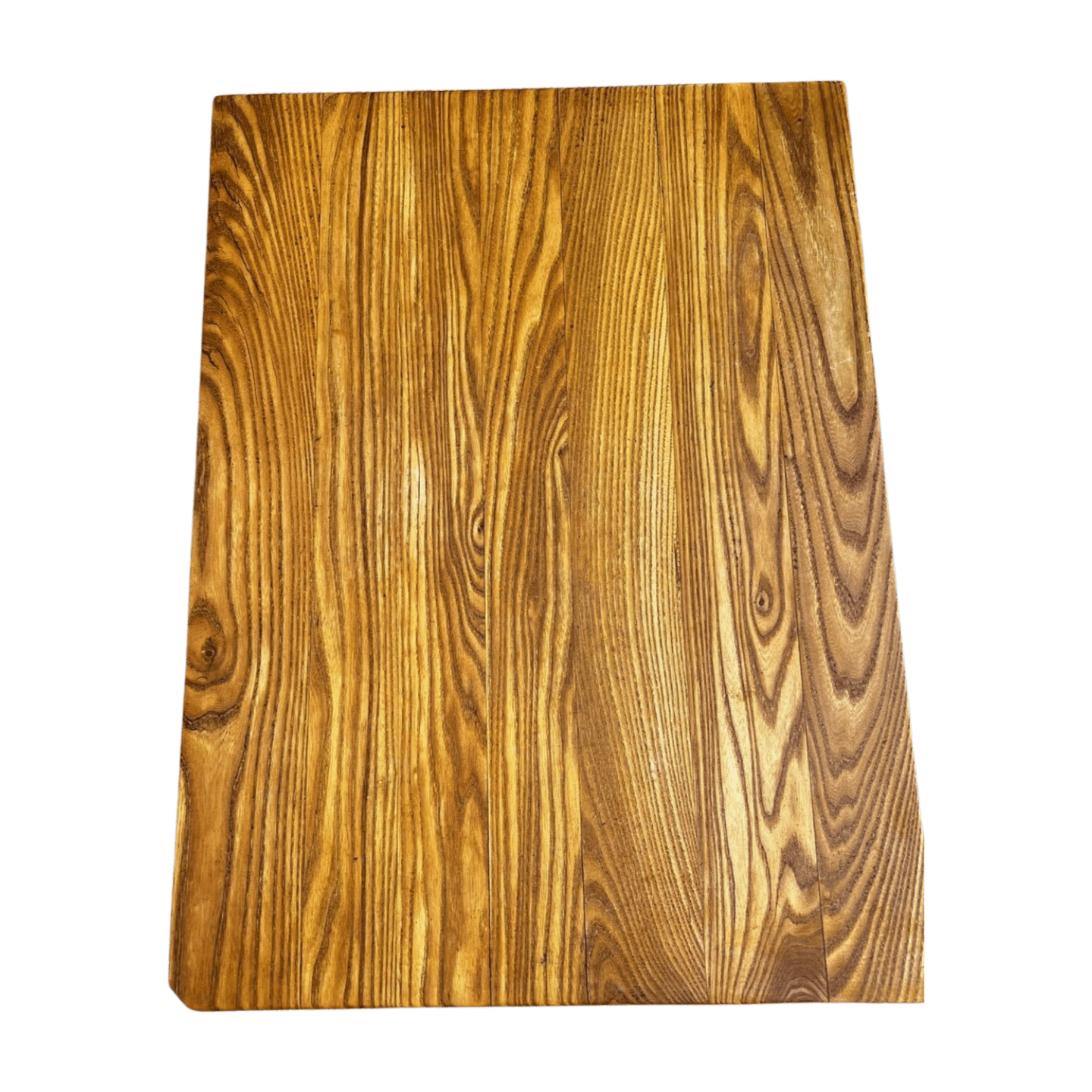
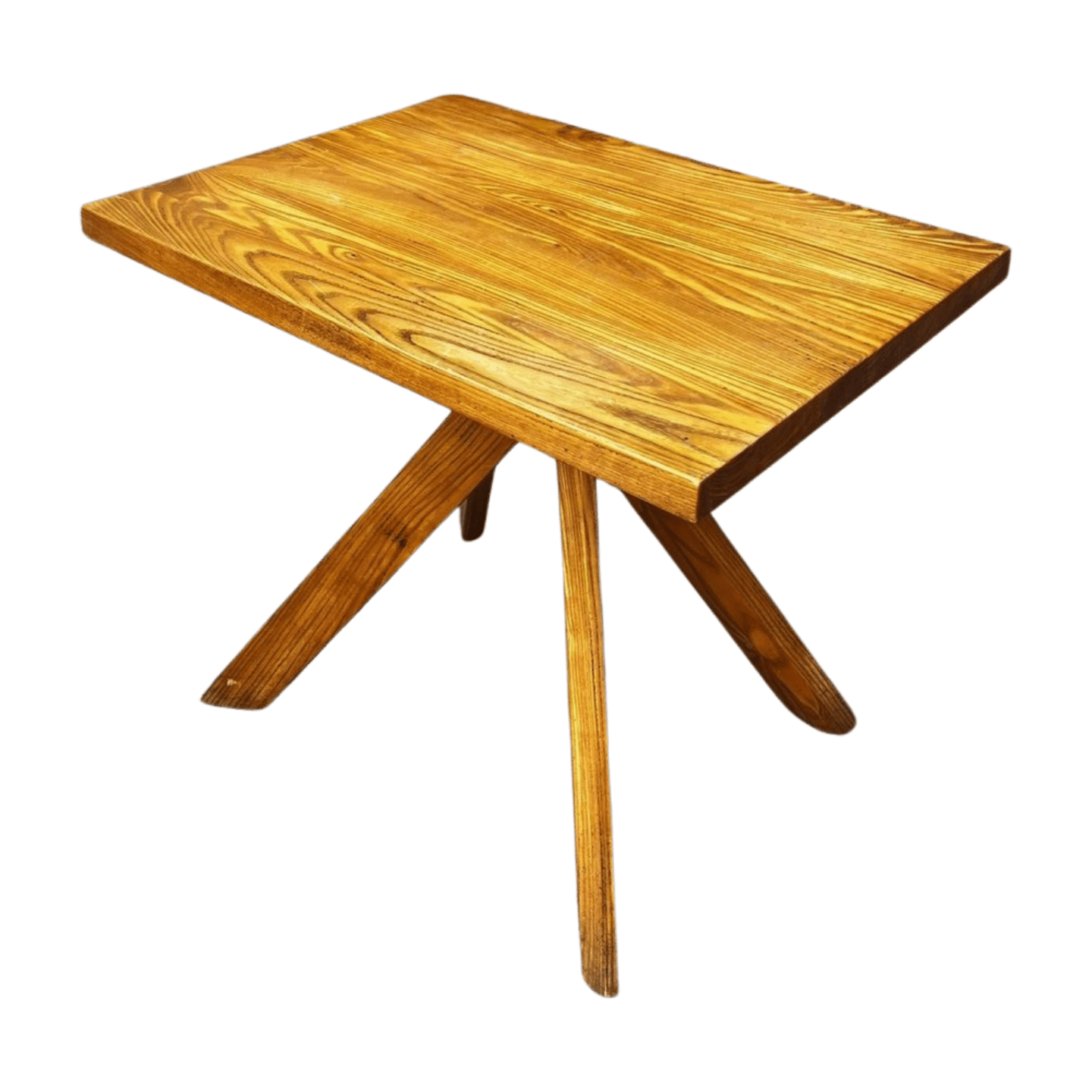
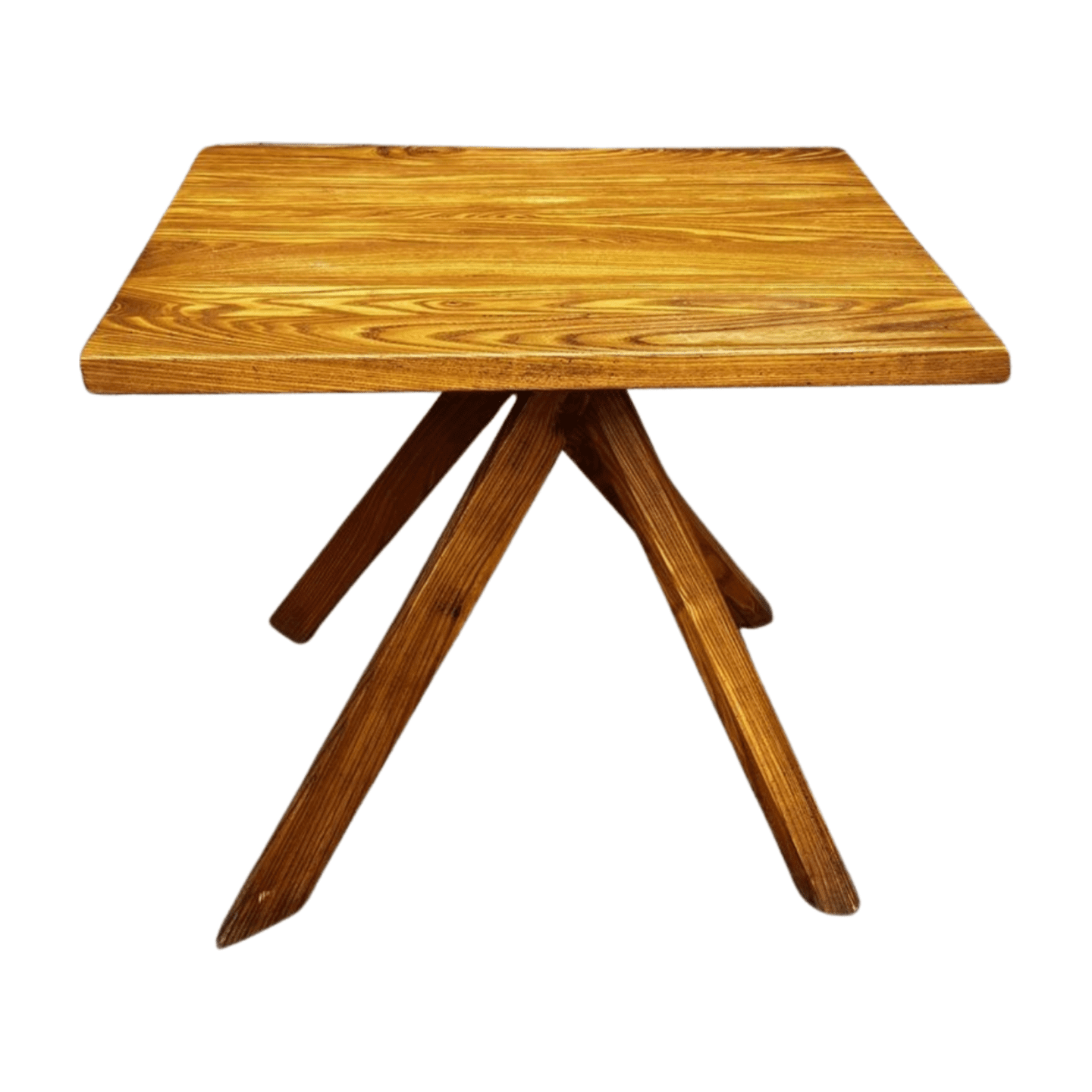
Pierre Chapo Table model T27A en solid pineSculptural X-shaped base. Design from 1965, generous top with expressive grain. Remarkable condition with a natural golden honey patina.
| Designer | Pierre Chapo (1927–1987) |
| Entry Date | 1965 |
| Model | T27A |
| Mouvement | French design, Mid-century modern |
| Materials | Solid pine |
| Color: | Natural pine with a golden honey patina |
| Plateau | L 173 × W 183 cm — thickness 6,1 cm |
| Total height | H 72,5 cm |
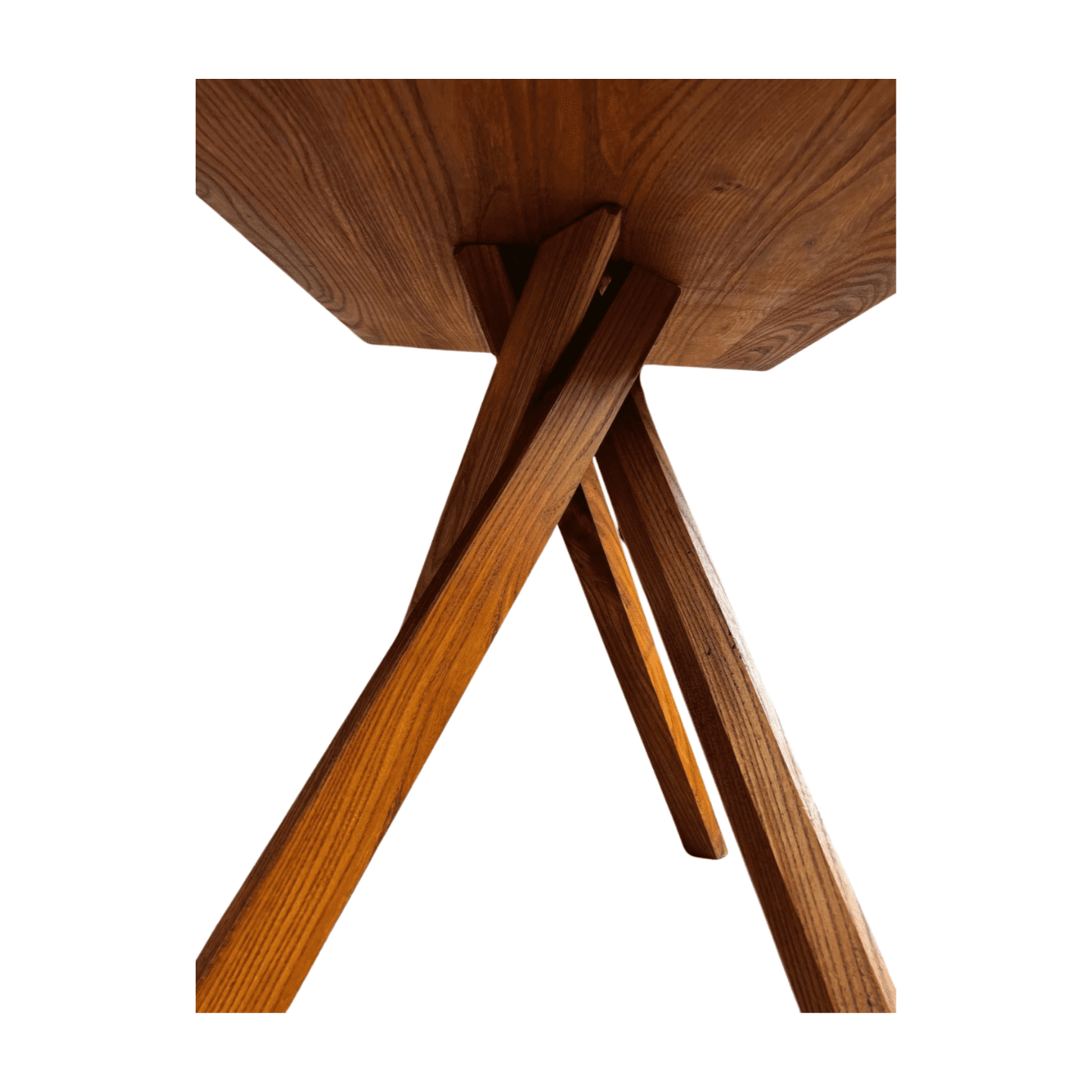
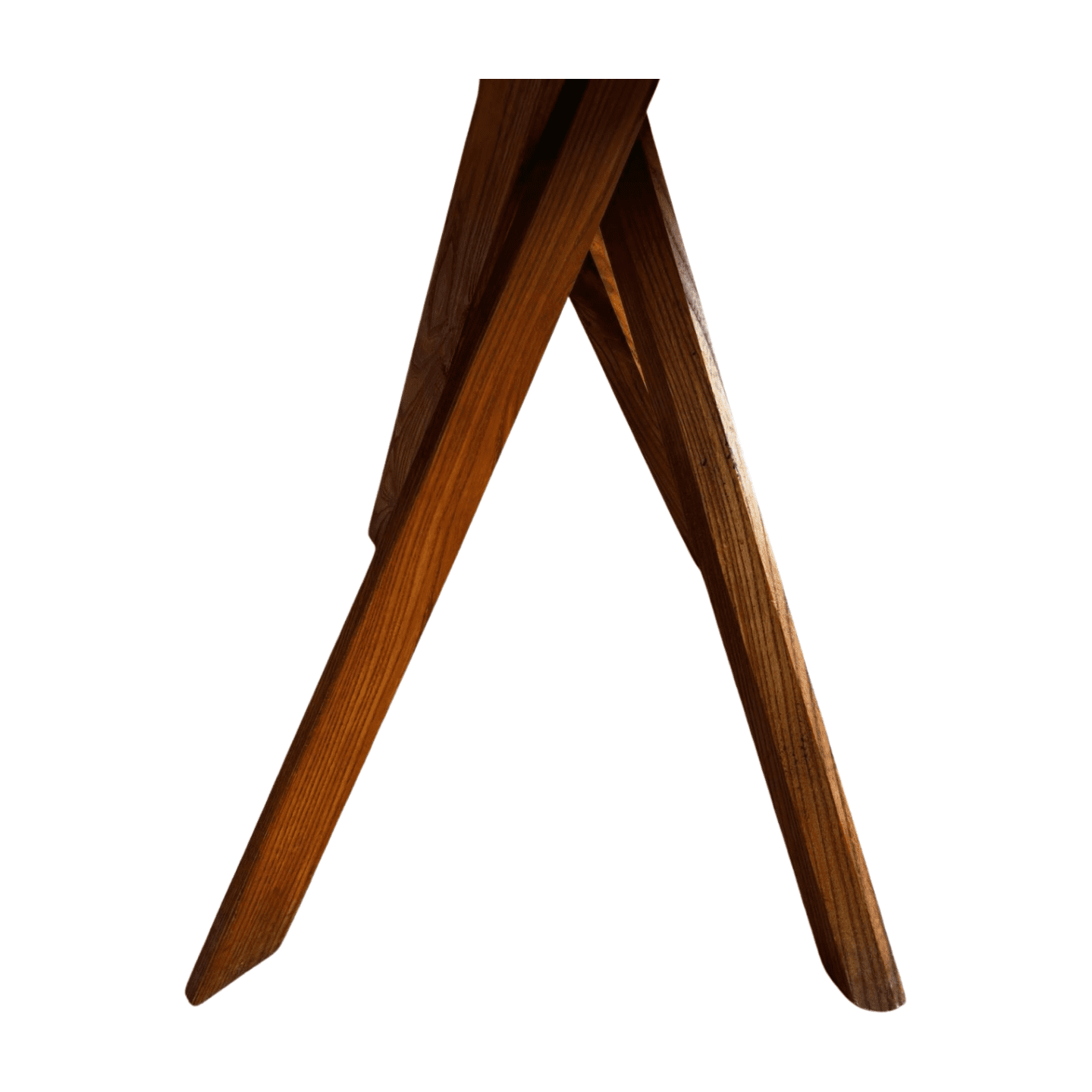
| Base | Double X crossed in solid pine |
| State | Remarkable — natural golden patina, no restoration |
| Documents | Model T27A referenced in the Pierre Chapo catalogue |
Sold
Be alerted of the arrival of a similar batch
Pierre Chapo T27A Table: Solid pine enhanced by the X-shaped base
Created 1965 the Pierre Chapo table The T27A model is the most accomplished expression of the French designer's structural mastery. Pierre Chapo (1927–1987), trained at the École nationale supérieure des Beaux-Arts in Paris, drew upon the legacy of the Compagnons du Tour de France, a rigorous approach to assembly that he combined with a resolutely contemporary vision of furniture. The T27A perfectly illustrates this duality: a sculptural X-shaped base of rare formal audacity, rooted in a centuries-old cabinetmaking tradition.
This model occupies a unique place in the Chapo catalog. While the majority of the designer's tables—T02, T05, T21—rest on straight legs or classic crossbars, the T27A asserts a strong graphic statement with its double X-shaped base. This architecture gives the table chapo remarkable stability while creating a dynamic interplay of lines beneath the tabletop, visible from any angle.
Solid pine: a choice with character
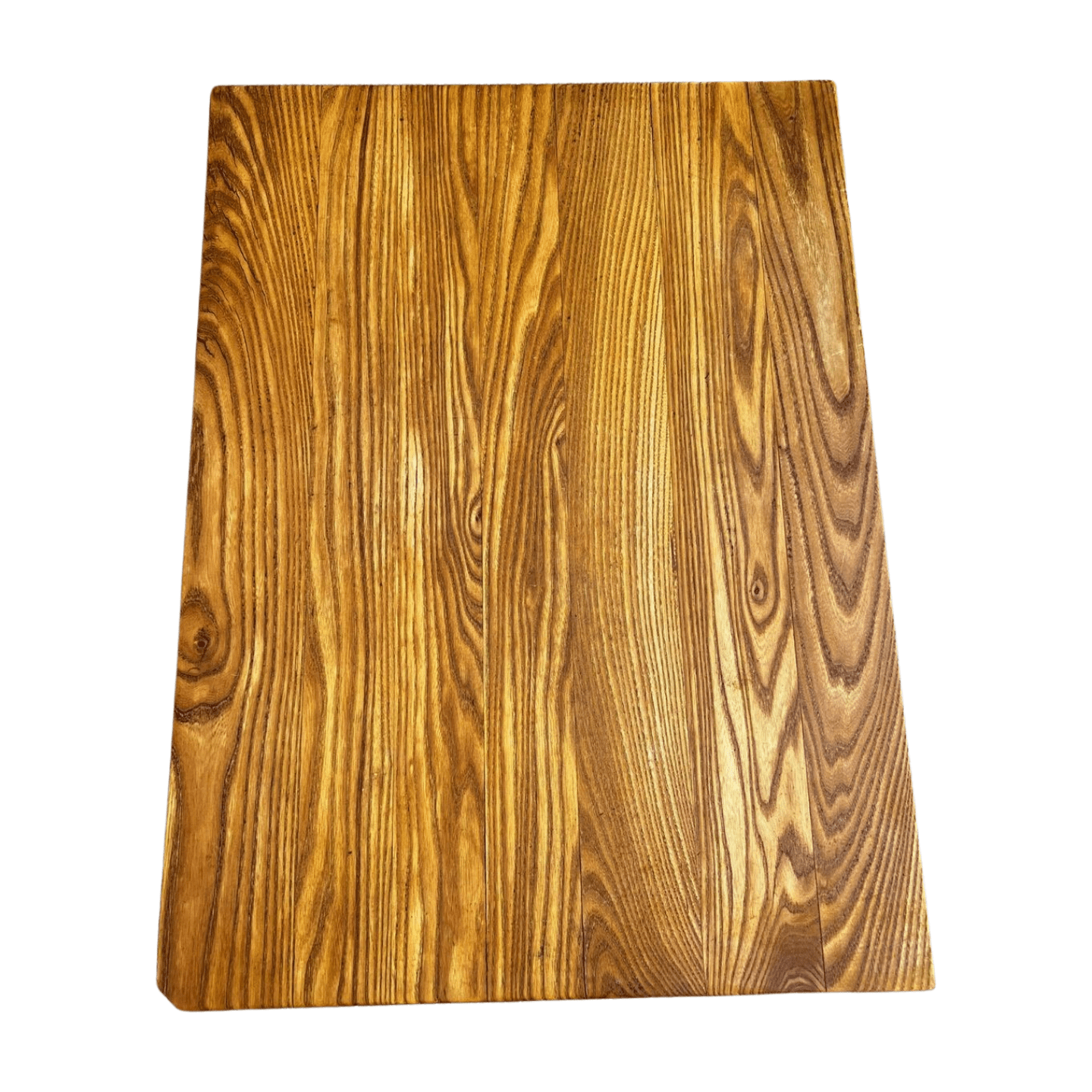
While elm remains the wood most associated with Chapo's production, solid pine occupies an equally significant place in his work, particularly for large tables. Pine offers ample and expressive grain, a regular texture, and a blond hue that naturally evolves to a golden honey over the years. Chapo selected large-section pine logs, allowing him to cut thick tabletops—here, 6,1 cm—without resorting to veneer.
The plateau of this Pierre Chapo T27A table It boasts generous proportions: 173 cm long by 183 cm wide, and 72,5 cm high. Its almost square shape makes it a dining table that comfortably seats eight to ten people, perfectly suited for everyday use as well as large gatherings. The thickness of the tabletop—6,1 cm of solid pine—gives the piece an imposing physical presence without being visually heavy.
X-shaped base: structure and sculpture
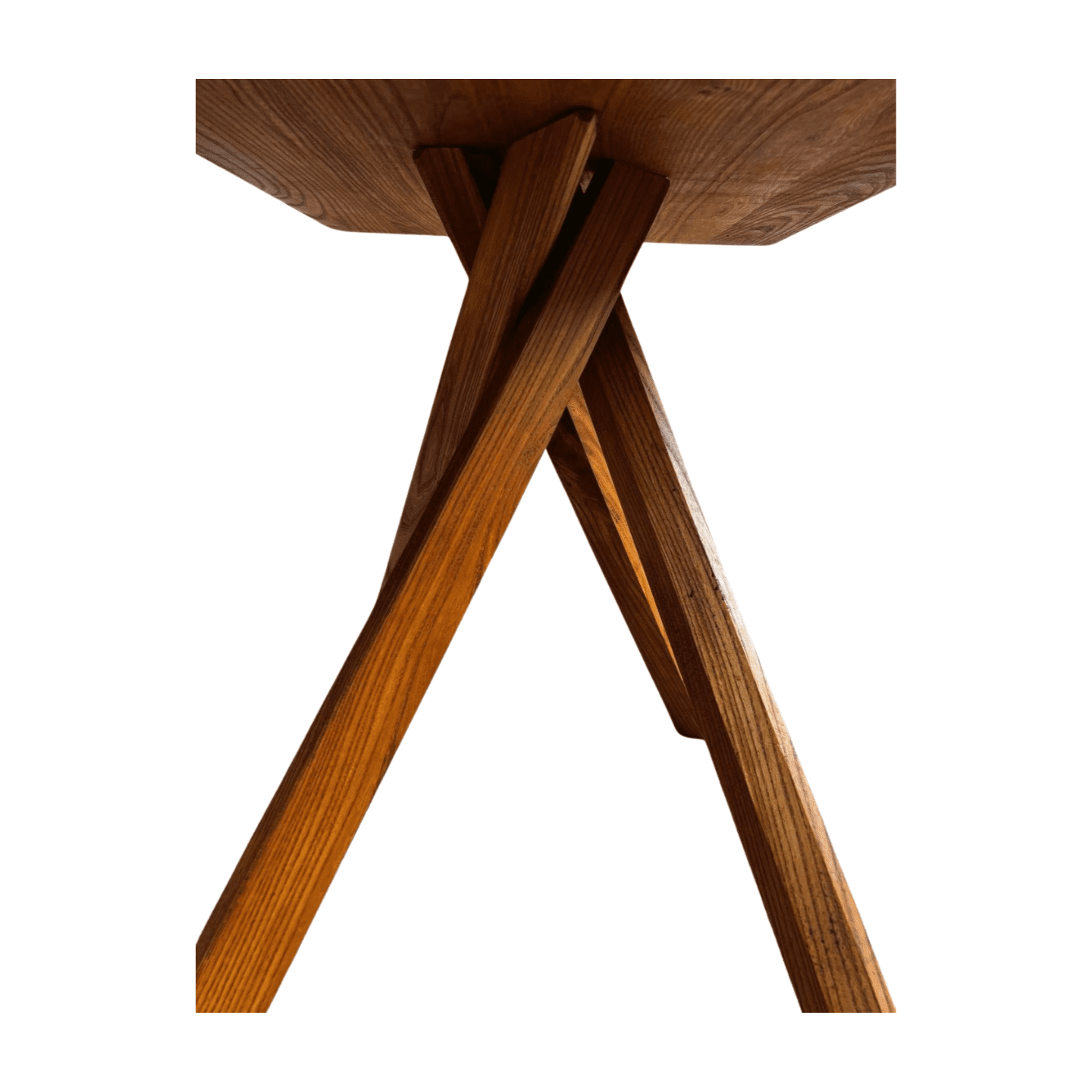
The X-shaped base of the table chapo T27A is a technical and aesthetic tour de force. The legs, carved from the same solid pine as the tabletop, intersect to form a load-bearing double X whose geometry ensures optimal weight distribution. The assembly relies on traditional mortise and tenon joints, without any metal hardware—a signature of the Chapo workshop.
Viewed from the front, the Pierre Chapo table It offers a dynamic and sculptural silhouette. The oblique lines of the base interact with the horizontality of the tabletop, creating a graphic contrast that breaks with the rigidity of tables with straight legs. It is precisely this tension between structural rigor and formal freedom that makes the T27A one of the most sought-after tables in Chapo's collection.
Conservation state
This Pierre Chapo table T27A is in remarkable condition. The pine has developed a deep, golden honey patina that beautifully highlights the wood grain. The tabletop is free of cracks, stains, or significant signs of wear. The X-shaped base is perfectly stable, with no play in the joints. The table as a whole demonstrates careful preservation over nearly six decades—a particularly noteworthy result for a dining table used daily.
Team Review The Auctionlab
The T27A is one of the most spectacular tables Pierre Chapo ever designed. Its X-shaped base is instantly recognizable—it transforms a dining table into a sculptural object. What we particularly love about this example is its patina: a deep, golden honey that only solid pine can develop over time, impossible to reproduce artificially. Its almost square dimensions make it a truly convivial table, equally at home in a contemporary loft or a country house. And the thickness of the tabletop—over 6 centimeters of solid pine—gives this table a physical presence that photographs can only imperfectly capture. T27A pine tables in this condition have become exceptionally rare on the market.
— The team The Auctionlab
Shipping Country: France, Jersey, Liechtenstein, Sweden, Denmark, Iceland, Latvia, Belgium, Finland, United Kingdom (UK), Ireland, Lithuania, Andorra, Greece, Italy, Portugal, Turkey, Gibraltar, Monaco, Spain, Hungary, Poland, Switzerland, Germany, Austria, Luxembourg, Bulgaria
Delivery status: Oregon (United States (USA)), Idaho (United States (USA)), Wyoming (United States (USA)), Kansas (United States (USA)), North Dakota (United States (USA)), Minnesota (United States (USA)), Alaska (United States (USA)), Nebraska (United States (USA)), Arkansas (United States (USA)), New Mexico (United States (USA)), Colorado (United States (USA)), California (United States (USA)), Oklahoma (United States (USA)), Hawaii (United States (USA)), Texas (United States (USA)), Iowa (United States (USA)), Utah (United States (USA)), Louisiana (United States (USA)), Montana (United States (USA)), Arizona (United States (USA)), Nevada (United States (USA)), Maryland (United States (USA)), Georgia (United States (USA)), Alabama (United States (USA)), Vermont (United States (USA)), Florida (United States (USA)), Washington (United States (USA)), Tennessee (United States (USA)), North Carolina (United States (USA)), West Virginia (United States (USA)), South Carolina (United States (USA)), New York (United States (USA)), Michigan (United States (USA)), Wisconsin (United States (USA)), Rhode Island (United States (USA)), New Jersey (United States (USA)), Massachusetts (United States (USA)), Pennsylvania (United States (USA)), New Hampshire (United States (USA)), Missouri (United States (USA)), Maine (United States (USA)), Mississippi (United States (USA)), Kentucky (United States (USA)), District of Columbia (United States (USA)), Indiana (United States (USA)), Delaware (United States (USA)), Connecticut (United States (USA)), Virginia (United States (USA)), Ohio (United States (USA)), Illinois (United States (USA))
Ready to ship in 3 to 5 working days from France
Shipping information
Delivery & Insurance
🚚
Worldwide delivery — Competitive rates & insured shipping
Delivery price
The delivery cost is calculated after the product is added to the cart.
For specific requests or multiple items, a personalized quote can be provided upon request.
France & Europe
- Small objects: Delivery within 1 week.
- Bulky products: Delivery time is 2 to 6 weeks depending on destination and carrier.
- Delivery type: at the bottom of the building or at the door (ground floor).
A premium delivery or installation service can be offered upon request.
International delivery
We deliver worldwide via carriers specializing in designer furniture and precious objects.
For an international quote or an estimate of delivery times, please contact us.
Packaging & Transport
Each item is packaged with the utmost care and entrusted to professional carriers.
To guarantee delivery in perfect condition, all shipments are systematically insured.
Return Policy
Returns & Refunds
↩️
Return conditions & refund procedures
In accordance with European regulations on distance selling, customers located in the European Union have a
14-day deadline after delivery to exercise their right of withdrawal, under certain conditions.
For more information, see our
CGU / CGV
or contact us directly.
We can also provide you with additional photos or videos of the product before purchase to help you confirm your choice with complete peace of mind.
Returns outside Europe
Outside the European Union, the right of withdrawal does not apply. Returns are therefore not accepted.
generally not accepted due to logistical and customs constraints.
However, certain specific situations can be studied. case by case.
We recommend that you carefully check all product information (condition, photos, dimensions, description) before confirming your purchase.
Auctionlab by(1 Reviews)
- Shop name: shop by Auctionlab
- Address: 49 bld saint denis, 92400 COURBEVOIE, France
- Phone: + 33146677289
Information request


Similar lots
-
 Pierre Chapo - Table and Bench Set T14A, Circa 1970
19 900.00 €
Seller
-
T18 Table by Pierre Chapo – Authentic Design in Elm and Ceramic, 1972
4 500.00 €
Seller
-
Pair of S38 Pierre Chapo benches in solid elm (1975)
9 900.00 €
Seller
-
Pierre Chapo — B19 desk in solid elm with return and drawers
9 400.00 €
Seller
-
Pierre Chapo — Pair of S20R stools in solid elm and Pierre Frey wool
6 850.00 €
Seller
-
Elm bench, Model S35 by Pierre Chapo - A 70s Design Classic
6 500.00 €
Seller
-
Pierre Chapo — Buffet R08 in solid elm, circa 1964
12 900.00 €
Seller
-
Pierre Chapo Dressing Table R05A and Stool S05Y in Solid Elm
9 980.00 €
Seller
-
Pierre Chapo — R16 sideboard in solid elm, four doors
27 900.00 €
Seller
-
Pine Bench by René Martin for Charlotte Perriand
2 160.00 €
Seller


